Meme Coin Trading, A Practical Guide to One Trade
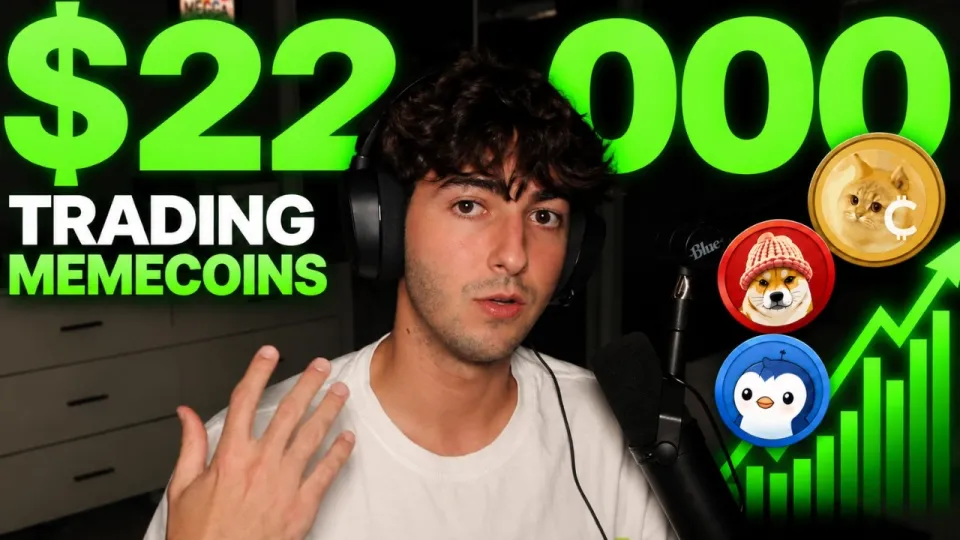
Video: How I Made $22,000 in a SINGLE Memecoin Trade (FULL GUIDE)
Need articles like this for your video? They help promote it on YouTube and Google — order them in the Telegram bot @sat_sit_bot. It writes articles around your video, embeds the video and publishes them on popular niche websites (no ads). Your first 50 articles are free.
· based on the channel Megga
A meme coin is a crypto token whose price is driven almost entirely by community attention, influencer posts and short-lived hype rather than by revenue or product fundamentals. Trading them profitably means treating each position as a timed bet on liquidity and narrative, with a hard exit plan written before entry. Megga's breakdown of a single trade that produced roughly $22,000 is a useful case study in how that process looks in practice, and beginners can start with the free guide at the Wiredd beginners course.
What a meme coin actually is and why prices move so fast
A meme coin has no cash flow to value it, so price is set purely by the balance of buyers and sellers in a thin order book. That structure explains the two signature behaviours of the niche: vertical moves in minutes and equally fast collapses.
Key mechanics worth knowing before any trade:
- Liquidity depth. A pool with a few tens of thousands of dollars in liquidity can move 40–60% on a single mid-sized sell. Check the pool size before sizing a position.
- Holder concentration. If the top 10 wallets hold a large share of supply, the chart is effectively controlled by a handful of people.
- Launch venue. Tokens launched on open bonding-curve platforms graduate to a public pool at a set market cap; that graduation is often the first moment real liquidity appears.
- Narrative. A ticker tied to a trending topic or a well-known account attracts flow faster than a technically identical token with no story.
The practical consequence: a meme coin trade is a liquidity trade, not a fundamentals trade. You are paid for being early and for leaving before the crowd.
How the $22,000 single-trade case is structured
Megga's video presents one completed trade rather than a portfolio, which makes the anatomy easier to study. The general shape of such trades is consistent: an early entry before broad attention, a rapid unrealised gain as the narrative spreads, and a staged exit into the buying pressure.
What separates a repeatable process from a lucky screenshot:
- Pre-defined invalidation. A level or a time limit at which the thesis is wrong and the position closes, regardless of PnL.
- Staged selling. Scaling out in thirds or quarters locks profit while keeping exposure to a further leg up.
- Position sizing tied to liquidity. Never hold a size you cannot exit in one or two sells without cratering the price.
- Recorded entry rationale. Writing down why you bought makes it possible to tell skill from a favourable market.
A single large win is evidence of a method only if the same method survives losing trades. That is the honest way to read any seven-figure-style profit screenshot, including this one.
The KOL factor and the doubts viewers raise
The most substantive criticism of influencer trade breakdowns is that the trader operates inside a network of large accounts, and that this network is itself part of the edge. That concern is legitimate and worth unpacking rather than dismissing.
Three separate advantages can inflate a public result:
- Information speed. Being in group chats with founders and other large accounts means seeing a token before it trends publicly.
- Distribution. A post to a large following creates buy pressure that a retail trader cannot generate.
- Exit liquidity. A big account can sell into demand its own audience created.
None of this makes the trade fake, but it does mean the outcome is not directly copyable. The realistic retail version of the same process is smaller size, slower entries, and a strict rule of never buying a token solely because an account you follow posted it. Treat influencer calls as a screening list, not a signal.
A workable checklist for a first meme coin trade
A disciplined first trade is small, documented and boring on purpose. The checklist below is the minimum viable process for someone moving from reading about meme coins to placing an order.
- Set a total risk budget. An amount you can lose entirely without affecting your finances — commonly framed as a small single-digit percentage of a trading stack.
- Verify the contract. Confirm the token address from a primary source, not from a screenshot or a reply.
- Check liquidity and holders. Pool size, top-holder share, and whether the deployer wallet still holds a large allocation.
- Define entry, target and invalidation before buying. Write all three down.
- Execute in tranches. Buy in one or two orders; sell in two or three.
- Log the result. Screenshot the entry, the exit and the reasoning.
Tools matter less than the sequence. A dedicated terminal such as the Padre trading platform speeds up execution, but the checklist is what prevents the common failure of buying a green candle and holding a red one.
Common questions from the comment section
Viewers of the breakdown repeatedly raise the same practical concerns, and they map neatly onto the risks described above.
The most frequent request is a small-account format: turning $25–$100 into $1,000. That framing is useful because it forces realistic sizing, but the honest answer is that percentage returns do not scale down automatically — fees, slippage and gas consume a much larger share of a $50 position than of a $5,000 one.
The second recurring theme is scepticism about trading without the influencer network, i.e. whether the same result is possible for someone with no audience and no group chats. The fair conclusion is that the edge shrinks considerably and the win rate drops, which is why risk per trade must be smaller.
The third is a request for explanations of adjacent formats — tweet coins, profile coins and community coins — each of which has its own launch mechanics and holder behaviour. Treat them as separate markets and learn one before moving to the next.
Useful links
- Free beginners guide: https://whop.com/wiredd
- Trading terminal: https://trade.padre.gg/rk/megga
- Twitch: http://www.twitch.tv/megga
- TikTok: https://www.tiktok.com/@meggafaze
- Twitter: https://twitter.com/megga
- Instagram: http://www.instagram.com/fazemegga
Final thoughts on meme coin risk
A meme coin trade can produce outsized returns, and Megga's roughly $22,000 single-trade breakdown shows what the winning side of that distribution looks like. It also shows why the niche rewards process over prediction: liquidity checks, staged exits and a written invalidation rule do more for a trader than any call. Read every public result as one sample from a noisy distribution, size positions so a total loss is survivable, and start with education rather than size — the free beginners guide is the cheapest first step. The channel Megga is the author of this breakdown and a useful reference for how professional traders narrate their own decisions.
Key takeaways
- Megga's breakdown covers a single meme coin trade that reportedly turned about $22,000 in profit.
- Memecoin outcomes depend mostly on entry liquidity, holder distribution and exit speed, not on charts.
- Free beginner material is offered via whop.com/wiredd; trading terminal access via trade.padre.gg.
- Viewers' main doubt: results may not repeat outside a KOL network and without an audience.
- Small-account challenges ($25–$100 to $1,000) are the most requested follow-up format.
Questions & answers
How much money do you need to start trading meme coins?
You can start with a small amount, but fees and slippage hit tiny positions hardest. A common approach is to risk only a sum you could lose entirely, and to keep each trade small enough that you can exit in one or two sells without moving the price.
Can the $22,000 result be repeated without an influencer following?
Usually not at the same scale. Large accounts benefit from earlier information, the ability to create demand with a post, and an audience to sell into. Without those advantages the win rate drops, so retail traders should use smaller size and stricter exits.
What should I check before buying a new meme coin?
Verify the contract address from a primary source, check pool liquidity, look at how much supply the top wallets and the deployer hold, and confirm the token has actually graduated to a liquid pool. Then write your entry, target and invalidation before placing an order.
Are tweet coins, profile coins and community coins traded the same way?
No. Each has different launch mechanics, supply distribution and holder behaviour, so the entry and exit rules differ. Learn one format thoroughly before adding another, and keep separate notes on what worked in each.
Source: How I Made $22,000 in a SINGLE Memecoin Trade (FULL GUIDE) · Markdown version